
Cursed
I probably need more therapy than I can afford

The subtitle is a taste of my dry and dark sense of humour. It made me smile when I wrote it. And now, somewhere, I hear the velvet voice of Vincent Price speaking these words: “That’s right. Go ahead, smile. It’s funny.”
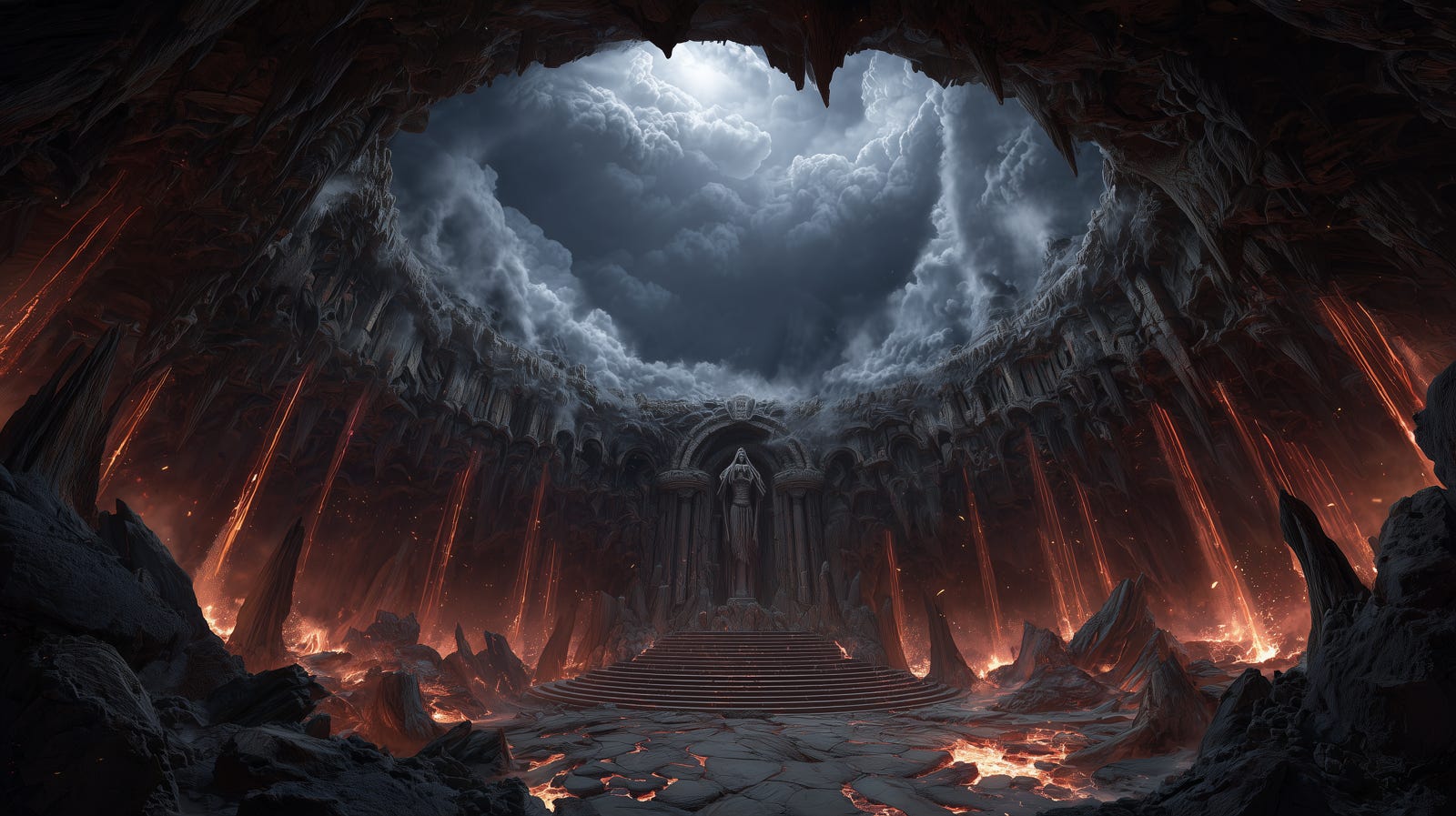
This is the first of seven strange rooms.
Pull up a chair. Take a load off the floor. I have wine and whisky to share. Or, take the doorway on the left and it will lead you out. I am not offended if you leave. Life is fleeting, and time is precious.
∅. Summons
This year I started to share my writing for the first time. Not just here, but anywhere.
This piece has been sitting in my Drafts folder from the start. Glaring at me like a gargoyle from the shadows. Entirely unwritten. Just the title. And the subtitle. The rest of the words lodged in my throat.
Of course, the gargoyle knows all this.
It sits, just outside the firelight, knowing its many things.
It sees more than I see. It hears more than I hear.
It refuses to speak.
Instead, it insists I speak for it.
As a rule, I do not speak.
It knows this too.
Long fingers with crooked claws extend from the shadows. It hands me a quill, carefully crafted from the feather of a raven. Then a bottle of ink. The liquid glimmers scarlet in the light of a single candle. Next it presses one stark sheet of white parchment across the heavy table; the paper hisses softly under its breath as it slides toward me.
The gargoyle withdraws into the shadows, and then it waits without a word. It knows what it wants. It knows that I know what it wants.
Truthfully, I do not want to write.
Not this time.
I am a grown man. I do not have to do anything I do not want to do. And I do not want to do this. But… as you can see… I am about to dip the quill into the ink.
I stopped writing for a long time. You should know this, before I begin.
I will not say for how long.
I should say for how long.
Probably I will tell you for how long.
This, dear reader, is another reason I do not want to write any of the words that follow.
My words will only lurch across the page. They will falter, and stumble, and embarrass us both.
I stand before two doors, so to speak. The first door opens on a small, cozy room with a fireplace that is cheerfully lit; the bed looks warm and the blanket seems soft. The second door opens on a cold, stone staircase; it spirals down into the dark unknown.
I always (and I mean always) take the stairs. Before I take my slumber, I need to see that no monster lies in wait at the bottom of the stairs. If I am devoured alive by some nightmare, then I wish to be awake when it happens.
Surely this makes me brain-damaged somehow. Ignorance is bliss, after all. We might not agree on anything else, but we are certain to agree on this. So what the bright, blue, blazing fuck is wrong with me, that I never (never (ever (ever))) deny the descent before I rest?
My will is free. I can take the first door and sleep in dreamless peace. Instead, I take the second door: I grip the cold iron railing and I make my way down the well of stairs, barefoot on broken stone, leaving the light and warmth behind. And I only hope to return…
I am nearly (but not entirely) anonymous here in the midst of this strange stack of papers.
I believe only three people know who I am: my oldest friend, more than thirty years now, he knows; and my two daughters, they know I am here. Everyone else (I think (I believe (I hope)) is a stranger.
Stranger or not, I prefer nobody read the words that follow. I will write them. Such is my doom.
But I will write them only if you promise not to read them. Do you promise? I will write for the phantoms of you and I, dear reader. For the future ghosts of us both, asleep in a space outside the time that follow this.
If you are still here... next to me… then I’ll ask one last thing: please close your eyes, at least.
And I won’t be mad if you hold my hand. All the candles have gone out, and it’s dark down here.
I. Symbols
I used an expletive in my prelude. That is the first I have used in any of my writing. It may be the last, I really don’t know. I suppose I’ll start with that. Expletives, I mean. It seems as good a place to begin as any other.
There are many (many) reasons I do not use expletives. I will share the main reason with you, and let’s see where that takes us.
My family was not wealthy. We didn’t own a computer. Growing up, there was never more than one car in our driveway. We had no garage. No car port either. (“Car port” still strikes me as one of the oddest terms in the English language, I don’t know why.)
Our television was black and white. There was a wire in the back that snaked out through a hole in the wall. It connected to an antenna on the roof. On good days, it caught the signal for two channels. On bad days it caught nothing but static. We didn’t own a VCR machine, because only rich people could afford those. DVDs had not been invented yet. Or maybe they had; I wouldn’t have known either way. Once a month or so, my father rented a machine from the video store. He’d bring it home in an enormous metal suitcase, like a bank robber who has knocked off an armoured car. Along with the machine he’d rent a pair of movies for the family to watch. Those evenings were special events.
Such luxuries and distractions were few, and far between.
Not one book was ever pressed into my hands. My insatiable appetite for reading was hardwired in. Looking back now, I know I was lucky, because our house was filled with books.
My sister did not read. My mother read one book each year, during summer holiday.
Once upon a time, I believed my father read a lot of books when he was young, and then less only as he aged. Today I no longer believe that. I once found his high school report cards in the crawlspace under the stairs of my grandmother’s house, and I was stunned to discover the cards filled with the letters C and D and E. There was not an A or a B to be found. He never attended college or university.
Now I believe he regarded books as symbols. Shelves heavy laden with books were a sign of status and intelligence, and he surrounded himself with them. I’ll not speak ill of the dead, and it was a happy coincidence for me — because whatever the reason, ours was a home stuffed with books to the rafters. For that I am eternally grateful. Because without books... Well, perhaps it’s best not to open the dark door to that room today.
II. Redactions
I probably read every book in the house. And there were a lot of them to read.
The older my father got, the more carefully the books were situated in the house. Books of a certain kind were to be found on the shelves in the living room, where visitors would be certain to see them. Books of another kind were located on shelves that lined the walls of our basement, where only friends and family could browse them. Books of another sort lined the bookcase in the guest room. And others yet were privileged with a place on the shelves in his private den.
There was never anything salacious or scandalous to be found, mind you. In fact, quite the opposite. If you look through them today (he’s gone now, so he’d not interfere with your curiosity) you will find a handful of books by Stephen King, for instance, and if you leaf through the pages of those then you’ll soon see he carefully blacked out all the expletives — along with any scenes he felt objectionable.
Some books he happened to misplace, and others he missed with his redactions, so I know the ones he never read.
Everything in the house was heavily censored. At least, everything that my mother and father could easily see. Music albums, and movies, and television shows, for example. Games and toys too. The list of things not permitted was long, and often mysterious to my sister and me. Smurfs were off-limits, for example. And so was Crest toothpaste.
The list of words we were not permitted to speak was much longer, and even more mysterious.
Every word that related to a bodily function was prohibited, for instance.
The words for many parts of the body were disallowed.
Words like “stupid” and “idiot” were treated with the same severity as any curse word.
The word “hate” was a four-letter word.
The word “love” was not forbidden, but it was spoken so rarely that perhaps it should have been. I recall my father saying the word once. It was among the last of his words, voiced only hours before he died.
Speaking of four-letter words…
One day when I was six, I learned a joke on the bus home from school. I waited all day for my father to arrive home from work, and I greeted him at the door.
Inside the front door he set down his lunch pail and started on the laces to his steel-toed boots. His work boots always smelled of sulphur. I sat on the steps and said, “Knock knock!”
He smiled and asked, “Who’s there?”
Immensely pleased with myself, I said “Madam”.
His eyes narrowed. “Madam who?”
Beaming, I said, “Madam foot’s caught in the door!”
That’s pretty funny, right? Especially coming from a smart and sweet-tempered six-year-old who has no idea he has just used a curse word.
My father didn’t laugh. He didn’t crack a smile.
The days when I discovered some new word on the blacklist are days etched sharp in my memory. Navigating from breakfast to bedtime was tricky sometimes, especially for someone who read as many words as I did. Some days it was like crossing a field of landmines... never knowing when the most carefully placed step might blow off a leg.
Even the Bible had words blacked out.
III. Icicles
In church one morning at the age of nine, struggling to sit through a tedious and tireless sermon, I did a little reading of my own, from one of the Bibles that slept in a bracket on the back of the pew in front of me. (I still love the pairing of the words “Old Testament”, by the way. That phrase has a magnificent taste, don’t you think?)
There were no words blacked out in this copy of the book.
On the drive home, from the back seat of the car, I asked for the meaning of one of the words I had found. It took a little time for me to muster the courage, but eventually I did, and I asked, “What does the word ‘circumcision’ mean?”. It was a word I had once heard spoken from the pulpit, so I judged it a safe question to ask.
The temperature in the car dropped ten degrees.
This was a Forbidden Word. Immediately I wanted to withdraw my question, of course. But how? I had stepped on a landmine, and now I was afraid to move.
There was a very long silence. My mother stared straight ahead. There was no reassuring backward glance over her shoulder at me this time.
Finally, when he answered, my father said, “It is something they do to young boys.”
He said nothing more, and I did not ask. To this day, it ranks as one of the most ominous things I have ever heard anyone speak. Clearly, this meant something terrible was done to a secret and shameful part of the body of a boy; a part with a name I was never permitted to speak.
For days and weeks and months (and years) I wondered… What did they do? And who were they? And why did they do whatever they did? And what had those boys done to deserve it? And what would happen if I committed such a crime, unknowing the crime or the consequence? Would they come for me? Was he one of they?
I had a creative mind, with an imagination that often ran wild. You can imagine some of the places it carried me…
IV. Disappearances
And yet, despite all that, as I said, the house was filled with books. And I read them all. I was reading Charles Dickens and Mark Twain and Lewis Carroll by the age of nine. C.S. Lewis and Ray Bradbury and H.P. Lovecraft by the age of ten. Stephen King and Clive Barker by the age of twelve.
Things regularly disappeared from the house, and that was often how I discovered some new rule had been broken, or some boundary had been trespassed. It was exceedingly difficult to predict.
Books, on the other hand, (apart from careful blackouts on pages within some of them) did not disappear. My father redacted words, but he never burned books. He burned many things, but never books. I know he read Fahrenheit 451, because we talked about it once, and he did not like the look of a world without books.
Actually, one book did disappear. (And yes, of course, I remember it.) The book was titled Helter Skelter. It was the story of Charles Manson, written by attorney-turned-author, Vincent Bugliosi. It was on the shelf in the basement, for some inexplicable reason. I remember the cover. I might have been twelve or thirteen years old. I had not yet finished reading it, but one of my parents must have noticed it in my hands… because when I set it down on the arm of the chair to get a glass of water, it was gone when I returned.
V. Senses
That is a very long (long (long (long))) way to say: I read. Quite a lot.
I could sit on the sofa in the living room window for hours and read.
Books upon books after books.
I still love the look of them.
The feel of them.
The smell of them.
The sound of them.
The taste of the words inside them.
As you might expect, when I was old enough, I started to write a few words of my own. I filled pages with fictions and reflections, throughout my childhood and teenage years, and then into the first few years of my twenties.
Not long after I married, I stopped. I was twenty-three.
∅. Stairs
What’s this? A heavy door blocks our passage. Let me try the handle.
I’m afraid it’s locked. Shall we turn back?
No? Then let me see if I have the key.
.
Ah, here it is. Old and badly rusted. It is thin and brittle. It may turn the lock, one last time, and then the key is sure to break. Are you certain of this?
Very well.
(— tick — tick — tick — tock — snap — and then — thump)
There, the door stands open.
I had not considered it before… if we return home this way… then we won’t be able to lock it behind us. Now our doom is sealed, I suppose.
The passage is no longer blocked. Shall we see what awaits on the other side of the doorway?
As I thought. Another well of stairs. Leading down. Shall we go deeper?
Very well.
(— inhale — hold — exhale —)
This time I shall ask it plainly: please, take my hand.
I remember this place now.
Your writing is so immersive and emotionally surgical. Just brilliant
I do think you need more therapy but maybe more ink.